
Does shelter access impact Chronic Homelessness?
Cities around the US vary in the amount of shelter access that they provide to their unhoused population. Boston, for example, has an impressive shelter rate of 96%, while Los Angeles only has a shelter rate of around 35%. Chronic homelessness is a term given to individuals who experience homelessness for a prolonged period of time, and can be used to determine the severity of homelessness within a given area. To find the relationship between shelter access and chronic homeless rates, I conducted an Independent Literature Review, and the results I found were shocking.
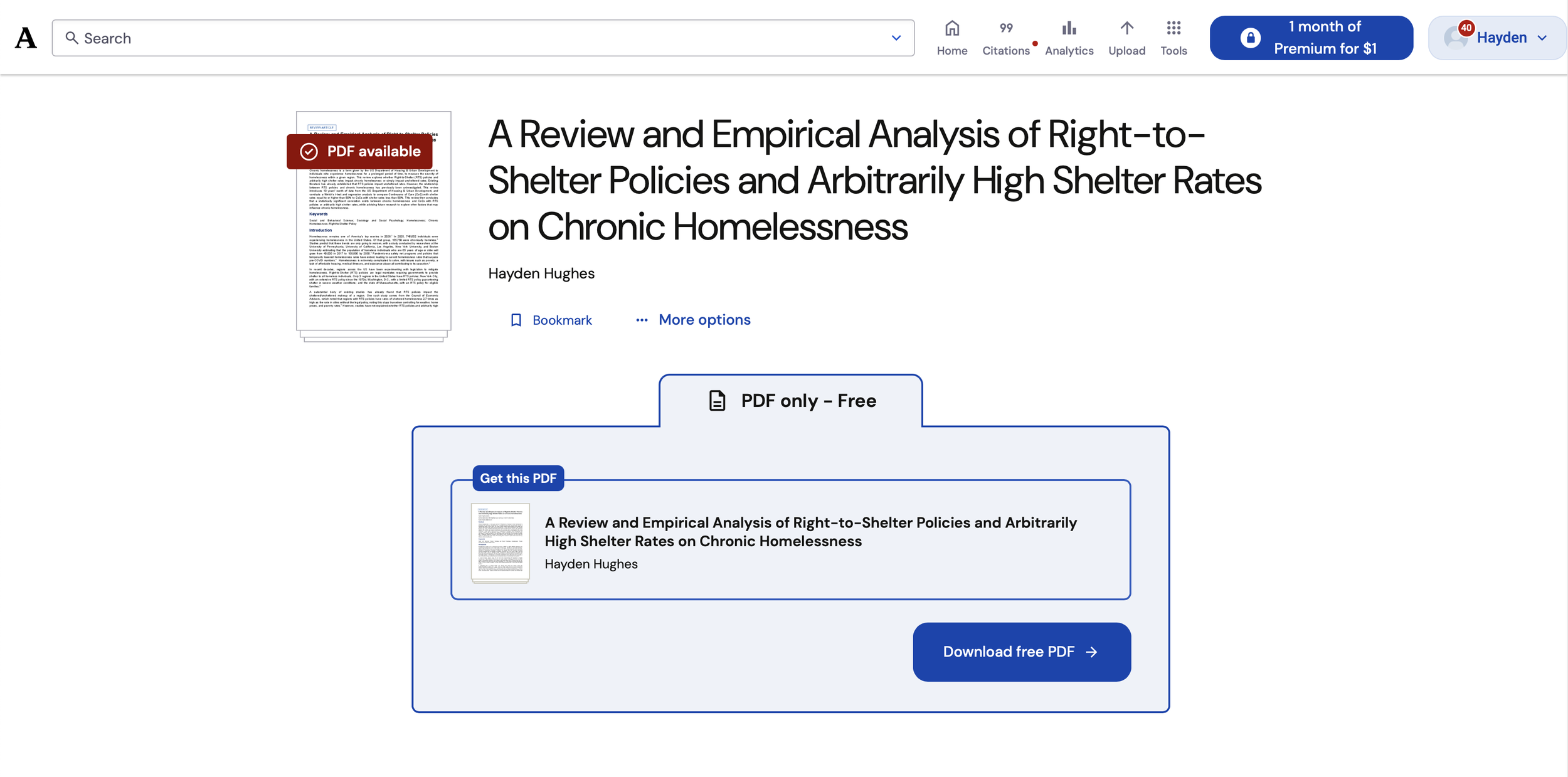
A Review and Epirical Analysis of Right-to-Shelter Policies and Arbitrarily High Shelter Rates on Chronic Homelessness, posted onto Academia.edu
What I did
I first found existing research that has been done on chronic homelessness and shelter access. A study found that permanent supportive housing does correlate with a decrease in chronic homelessness, but no studies have directly analyzed the relationship between chronic homelessness and shelter access.
I decided to find this relationship on my own. Every year, the US Department of Housing & Urban Development conducts a Point In Time count to track homelessness around the United States, including shelter rates and chronic homelessness. Using 10 years’ worth of HUD data, I ran a Welch’s t-test and regression analysis. With the results of those, I concluded that there is a statistically significant relationship between shelter access and a decrease in chronic homelessness.
Of course, I just heavily summarized and condensed the processes and conclusions that occur throughout my research, so if you would like the in-depth version, feel free to reach out to me or view the paper on academia.edu while I wait for it to be published in scientific journals.
What does this mean for the future?
Homeless rates continue to rise in the US, but if we know that increasing shelter access can limit the severity of homelessness, then we must push for higher shelter access within the United States. Of course, these findings are only correlational, and there is still the possibility of other factors contributing to this relationship. Nonetheless, cities around the US should take an interest in these statistically significant findings.